Wednesday, May 15, 2013

My first few weeks in Peru


I am two and a half weeks into my Peru trip so far, and there is so much I can write about that it’s overwhelming and intimidating to think about! I wish I could have written this sooner, but there is only so much time in the day to spend writing a blog, and only so much internet access. 

I will try to write with a balance of brevity and sharing the important details. 

After spending a lovely week in Orlando visiting my sister, brother-in-law, and their two precious daughters, I flew to Lima, Peru. I arrived in the evening and was greeted at the airport by my couch surfing host, Ingrid. She took me to her very humble apartment where we spent a couple hours speaking only in Spanish, then went to sleep. The next day, I boarded a bus to Puno, which is on Lake Titicaca on the border of Peru and Bolivia, where I was to meet up with my girlfriend Mary and her friend Juanita.  It was supposed to be a 23 hour non-stop bus ride, but ended up being a 27 hr bus ride with three bus changes due to my first bus breaking down a few hours into it. I finally arrived in Puno, two and a half days after leaving Florida, only to find that Mary and Juanita were not at our hostel. Unfortunately, I could not tell them what time I would be arriving, so they did not know when to expect me. So I waited in our hostel for another couple hours until FINALLY being reunited with my girlfriend after 2 months of being apart.

We spent three days in Puno, did a boat tour of Lake Titicaca, walked through some old Spanish cathedrals, and took it easy while we acclimated to the altitude (12,000ft). Puno is not a very exciting or pretty city, so we headed out to Arequipa, Peru’s 2nd largest city. It’s also known as the “white city” due to a certain type of white rock found there that most of the buildings are made out of. It’s beautiful, has a nice downtown and plaza, and is overlooked by three or four towering volcanoes. We met some rock climbers there, and they took us climbing two days in a row on the outskirts of the city. 

After a few days there, we took a bus up to Cuzco. I was very excited to see this city since I had heard so many glowing reviews about it. And everyone was right, it’s a beautiful city with a lot of life. It’s also very touristy, since it’s the starting point for Machu Picchu! We spent just one night in Cuzco before embarking on a four-day Inca Jungle Trek to Machu Picchu.

Day one of our trek consisted of cycling down a windy mountain highway, starting very high in the clouds and descending thousands of feet over a few hours. We had amazing views of the Andes, they looked exactly how I imagined them to be. That night, we were put in a hostel where Mary and I bonded with many of our group members. There were around 15 of us, most of them around our age, and from all over the world. Everyone was nice and lovely and we made some great friends in that group!

Day two was nine hours of hiking through forests and through canyons and along rivers, seeing many of Peru’s local crops (bananas, coffee, corn, and coca). Our guide, a Peruvian man named Guido, spoke English well enough to educate us along the hike. Again, the views of the Andes were spectacular. Later on in the hike, we had to cross a deep canyon. The problem is, there is no bridge. So the locals built a metal basket that is suspended by metal cable connected by pullies on either end of the canyon. We sat 2-3 people at a time in this very small basket (with nothing to secure us in it!), and men on either side of the canyon pulled us across! It was a rush, but I made sure not to let my fear of heights overpower the experience! (I took video of our passage across the canyon, so I’ll be sure to share it once I have a chance to upload it) The hike ended at some hot springs, which was a great way to relax our tired muscles. 

Day three was a more mellow hike than day two. Again, we hiked through the mountains, saw great views, learned more from our guide, and we ended in the town of Aguas Calientes, which is just outside Machu Picchu.

On day four, we woke up at 4am to begin our ascent up 1,800 steps to Machu Picchu. We arrived at the top hoping to be rewarded with stunning views of the ruins, but instead were “rewarded” with the sight of a modern gateway building, a line to wait in, and no ruins. Luckily we only had to wait there about 10 minutes before they opened the gates and let us in. Guido gave us a two-hour tour of the ruins, educating us on the history, the culture, and the architecture. Then, many of us climbed to the top of Mount Machu Picchu, the highest peak in the nearby area. After climbing for about an hour and ten minutes, we reached the top and had the most amazing views of not only Machu Picchu, but all the surrounding mountains. Mary and I packed a lunch and ate with a better view than most restaurants in the world can offer. By around 2pm, we returned to the ruins and found that the crowds had seriously died down and it was very quiet. We enjoyed casually strolling the grounds, taking many photos, stalking grazing llamas, and soaking it all in while we could before having to leave. We were both blown away with the whole experience of the day. Luckily it’s a world heritage site, which means nothing can be built there, not even bathrooms, so it’s very preserved and uncorrupted by tourism. We left at 4pm, ate dinner in Aguas Calientes, and took a train and a bus back to Cuzco and returned to our hostel there. 

We spent another few days in the beautiful city of Cuzco, but most of our time was spent at our hostel. It is run by a young Austrian couple who are very sweet, and they allow people to volunteer there in exchange for lodging/food. The volunteers there were all fun, lovely people, and we decided to spend a day painting one of the rooms in the hostel with the other volunteers. We were fed for the day and given two free nights of lodging! 

Juanita, after spending several months traveling around South America, had to head to Lima to fly out to England, so Mary and I joined her on a 23 hour bus ride to Lima. Juanita left early this morning, and to quote Timon and Pumba, “our trio’s down to two”. She is one of Mary’s dearest friends, someone I’d spent my last year in Korea hearing wonderful things about. So it was so nice being able to travel with her these last two and a half weeks and finally get to know her in person and not through stories.
Mary and I will soon be heading East into the Amazon to work on a small family farm in the jungle. We don’t know how long we will be there, I guess it depends on how we like it, and how long we can handle the rough jungle life! (I would like to think I am tough enough to handle it, but I do also like feeling clean at the end of the day, having internet, and a clean toilet, so we’ll see…)

So that’s it for now. Once we get to the farm, internet will be very scarce, so don’t expect to hear from me too often. But of course I will try to get online every few days to at least tell the world that I am alive and well.

Wednesday, March 13, 2013

Final Thoughts from Korea, Take 2

This is my last day in Korea, and I may never be back. I know I thought that the last time I left, and returned just 2 months later. However, I have a feeling this departure is more permanent.

I just reread my blog post from the last time I left Korea, and I don't want to repeat any of that in this blog. I still feel that everything I said then was valid and relevant, and I don't have a lot of new perspectives to add about Korea.

I will start this post by describing Korea using the five senses so you can get a better idea of what life is like here.

Korea has some funky smells, and often they hit you without warning. Common is the odor of sewage that wafts through city streets and lets itself into shops and restaurants, slapping you across the face. Also common is the smell of fish, raw or cooked, and never pleasant. Though, one can usually predict that smell since you would need to be near a fish market or restaurant to smell that odor. Summertime is particularly unfortunate for anyone riding in a cab, as most cab drivers are combining their year-round bad breath odor with their summertime B.O. Windows down, please! For a short window of time, the cherry blossoms bloom in early spring, releasing their most pleasant fragrance into the breeze.

Sounds vary from place to place of course. If you walk into a mini mart, the door will play a happy little tune like "It's a Small World". The school bells aren't annoying screeching sounds. Instead, they are also catchy tunes like "Home, Home on the Range" (because all kids feel at home when they're at school!). There is always the pounding of construction to be heard in most neighborhoods of Pohang as they continue to develop the land. At night, I was often serenaded by cats fighting or cats in heat. On occasion, a young man will be walking and singing some hip tune, or an older woman will be hiking and singing a Korean folk song. Cell phone stores love to blast K-Pop music, while cars don't blast any music. Older men and women pushing cheap food carts yell through megaphones something in Korean, usually saying, "I have oranges! I have oranges!" And it wouldn't be Korea if you didn't hear "Gangnam Style" on a frequent basis.

I have tasted a lot of garlic, sweet potato, rice, cabbage, beef, chicken, pork, eggs, spicy sauces, soups, dumplings, ramen, seaweed, bulgogi, cheap donuts, terrible cake, anything and everything made out of rice, weird parts of animals that you just have to close your eyes and swallow, and of course kimchi.

I have felt a thousand children's hands, a lot of sand between my tows, a lot of people pushing past me, my legs cramping up while sitting on restaurant floors, chopsticks in my hands, and mosquitos in my ears.

I have seen millions of people consumed by their smart phones, countless couples wearing matching outfits, people dressed in animal costumes (myself included), elderly ladies who are permanently bent forward, men holding hands, people making the peace sign for photos, people forming hearts with their hands for photos, taxis everywhere, coffee shops on every block, Hyundai and Kia, cell phone shops on every block, young ladies dancing outside of cell phone shops, men stumbling drunkenly down the road, dragonflies, praying mantises, magpies, crowded fish tanks with the ugliest fish I've ever seen, octopus tanks, and small dogs with dyed fur.

People keep asking me how I am feeling as my time here is winding down. And quite frankly, I feel fine. I am not too sad to leave Korea, though I will miss my friends. I am excited to come home, see my family, friends, and dog, and to eat some wonderful food that Korea is missing out on. I can't say if there are things I've learned from Korea, or if I have changed much because of Korea. I think if I have, I will notice once I've left and immersed myself back in my own culture. I guess I can say for certain that I have become more adventurous from this experience, more comfortable in foreign situations, and hopefully a better teacher.

It's also hard for me to predict what I will miss, but I do know what I will cherish. Obviously the memories of all the fun I had, and the memories of my students, my friends, and the memories of building an amazing relationship with my girlfriend, Mary. But I will also cherish the small relationships I built with Koreans in my community, people like the owner of the local bakery who one day handed me his guitar, opened up a sheet music book to "Let it Be", and asked me to play; or Choi Ju Won, the somewhat mentally challenged gas station attendant who pumped my gas every week and was always excited to see me and tell me all the foreigners he knew; or Tailor Joe, who, creepy as he may be, does great tailor work, provided me with four beautiful silk robes for my family, and is a really decent guy; or Bede, my favorite barista at my favorite coffee shop who always remembered my drink and often gave me free oreos; or the art teachers I gave English conversation classes to, and particularly our class discussion on broken hearts when most of the class told their saddest personal stories; or Tom, one of those art teachers, who I had coffee with one night while conversing about religion, philosophy, and music; or the lady at the little diner near my work who always smiled at me the way a mother smiles at her boy; or the man who owned the little market, and although we could not share a word with each other, we both always seemed to share a general happiness to see each other; or the men at the climbing gym who would occasionally help me improve my form, even though they spoke no English.

I've had a hell of an experience here these last 18 months. But as incredible as it's been, I do feel very ready to move on to the next chapter. In 24 hours I will fly back to the States where I will spend a month and a half seeing friends and family. Then, I will fly to Peru where I will meet up with my girlfriend and we will embark on our next big adventure. We don't have much planned while we're there, just to travel, volunteer, and find some work. It will be very improvisational, which would have scared me 2 years ago, but now I feel pretty comfortable with.

So that's it. Goodbye Korea. Hello America, then South America! I guess I will have to rename my blog to "Teaching, Learning, and Other Adventures in the World".

Thursday, March 7, 2013

"The celebration of life, rather than the contemplation of ending it."

You may or may not be aware that I have taken part in a recently formed "organization" in Pohang called Salja. Last fall, my parents, in their infinite wisdom, said that although they were happy that I was having so much fun out here, asked if there a way I can give back to the community. And that's all they needed to say for me to realize that I very well could be spending some of my time serving Korea, a country that has given me so much fun, so many adventures, so many new perspectives. Mary and I discussed this, and pondered what a good cause would be to serve in Korea. Poverty is not really a problem here, nor is crime, or drugs, or unaffordable health care. But one thing that is a major problem in this country, one that we teachers are especially concerned with, is suicide. Korea has one of the highest, if not the highest, suicide rate in the world. It's the leading cause of death for Koreans under the age of 40, but is really a problem for any age group. This was a cause Mary and I could get on board with.

We knew that some foreigners held a few discussions last summer to address the suicide problem here, so we contacted them to find out if anything was followed through with their discussions. It turned out that a few of them decided to make a group called Salja, which is Korean for "let's live". Since nobody in the group is a trained professional in suicide prevention, the goal is not to intervene with people personally in their contemplation of suicide. Rather, the goal is to spread messages of celebrating life and spread hope that it's worth hanging on and finding out what more life has to offer. Furthermore, Salja aims to spark a much needed conversation in Korea about why the suicide rate is so high, and encourage the country to be proactive about this problem. So Mary and I decided to spend the rest of our time in Korea helping out Salja and doing what we could to get this organization off the ground and to spread its messages.

We entered this group when it was very young, and it only had so much as a mission statement and a website (www.salja-korea.com). So clearly there was not a lot of momentum built yet. Furthermore, the few members the group did have, as well as Mary and I, were all leaving Korea at the end of winter. So we knew we had only a few months to get the ball rolling, build some momentum, and get Salja's name and message out in the open.

We began with the production of a very low-budget film (and by low-budget I mean no-budget!) called Tomorrow is Worth It. We interviewed various friends, both Korean and foreign, asking these three questions: Why is tomorrow worth it? Have you ever felt that tomorrow wasn't worth it? What was the last thing that made you smile?

Our inspiration for this video was the "It Gets Better" series of youtube videos that were made in response to the high number of gay suicides in America a couple years back. We wanted to spread a similar message to Koreans, particularly Korean youths, to say that although times are hard now, tomorrow is worth it. Don't give up. After seeing so many inspirational videos go viral on youtube, we figured it doesn't hurt to try to make our own videos to spread to the world! Maybe they'll go viral as well, or maybe just one person will watch and be inspired. Either way, it's worth the effort.

Since I had the free time and technological know-how, I edited the whole film. It was quite a process getting it made, and took us about 3 months. But we finally finished and are so happy to get it out to the public! And if you care to watch (it's about 11 minutes long), click the link below:

http://www.youtube.com/watch?v=AyX-h9wfdbg

We have also made a few other videos, including a short introduction to who Salja is and what we do, and I also made a video of my own personal message to appreciate the beauty that can always be found around us. To view those videos (both only a few minutes long), click the links below:

http://www.youtube.com/watch?v=yFyzaT_vRRM
http://www.youtube.com/watch?v=F8BPuAIiAC4

The group leader had a great idea to get Salja's name and purpose out to the public in Korea. On a few different occasions, a group of us went to a busy shopping area in town and gave out free hugs to anyone who wanted one. Oh, and we dressed in cute animal costumes as well! Anyone who got a hug received a small flier informing them about Salja. In one day, we handed out 400 fliers. Although we know giving hugs won't stop someone from committing suicide, or give our group huge PR, we at least started getting our name out there, and we spread a little joy to people, which is what we're all about!


After a few months, we had created three videos, gave out free hugs, started getting our name out in the open, and held a few smaller events. But time was running out and soon the group members were leaving Korea. We tried very hard to tell everyone we knew about Salja to invite people to join the group and keep it going after we left. But much to our disappointment, we received very little interest from people. Some people have legitimate schedule conflicts, but we knew there were still plenty of people who had the time to help, and frankly we thought all teachers would be willing to get on board with a cause like this. It has been disappointing to see such little interest from a community that has tons of fun, but doesn't take much time to give back. Luckily, a few friends of ours have taken an interest in keeping Salja going after we leave, so we know the flame will live on. Our group leader was also able to get Salja chapters started in Busan and Daegu, so it was encouraging to know that even if Salja ended in Pohang, it would carry on in two bigger cities.

It's fascinating how Koreans are well aware of this suicide epidemic in their country, and they know why it exists. But it's something nobody wishes to discuss. For instance, last night in an adult conversation class I was teaching, we were talking about what makes each of us happy. We had been having a wonderful conversation, everyone participated and shared and we had over an hour of nonstop talking. I then asked the question, "Do you think Korea is a happy country?" To which they replied that it is not. I then segued to the question about Korea's suicide rate, asking if it's talked about much, or if the government is trying to be proactive about it. And the crowd went... silent. For the first and only time in the 90 minute class, nobody had anything to say. They nodded their heads in acknowledgement of Korea's high suicide rate. They nodded their head when I asked if it's something ignored in this country. And they themselves seemed to want to ignore it. It's almost as if the people know it's a problem, but solving it would cause more damage than is worth, so they would rather sweep it under the rug.

It is clear, and well-known, that the bulk of Korea's suicide problem is due to the high stress and pressure put on students and workers. The level of competition is unprecedented because they have a small country with many people and no resources. The people and their minds are Korea's resource. So it's a race to the top, the ultimate contest to not just be one of the best, but THE best. I have had students score second-highest on city wide exams and still face disappointment from their parents because they were not #1. Workers are killing themselves (metaphorically) at jobs working 12-15 hours a day, often on weekends as well, in a constant state of stress, in order to work their way up the ladder. But when I ask some of these workers if their job will become less stressful once they are promoted, they answer that it will always be stressful. But they put themselves through this torture to make enough money to fund their kids' education. However, their kids are now spending their entire day at school, at after-school academies, and studying in their rooms, stressing about exams and having no fun, all so that they can get a good job, where they will work long hours and have more stress until they retire. It seems to be a cycle of stress, pressure, and torture with no end in sight. So people at all ages are killing themselves (literally) to escape it all.

So my take on it is that if the country addresses the problem, that means parents and schools will have to put less stress and pressure on the students, which lowers student achievement, and employers will have to work their employees less hard, which will lower productivity. This country has built itself on backbreaking labor and studying, and has risen to the developed world in only 30 years. But I think they have reached a point where they now need to tone it down, take a step back, and realize that the riches, the technology, the advancements are not making this country any happier, but actually sadder, angrier, more stressed. They need to ask themselves if this money is worth the cost of unhappiness to the point of suicide.

I leave Korea in one week, so I have been doing what I can to set the stage for the new group of Salja members. It will be hard for me to walk away from it once I leave, because I have been steamrolling with this cause! But I feel proud that Salja was started, and that I was able to be a valuable member of the group. And I do believe that even if one person is reached through our efforts, it is all worth it.

Thursday, January 3, 2013

Climbing, hiking, hot springing, scooting, eating, monkeying: Christmas in Taiwan

To have an adventure, one must combine the proper ingredients: exploration of new lands, foreign experiences, leaving one's comfort zone, taking risks, getting lost (but eventually being found, otherwise the adventure becomes a mishap), and occasionally being frightened. And doing this all with a close friend or loved one adds a ton of happy to the adventure!

My latest adventure took place in Taiwan. My girlfriend Mary and I spent 9 days over the holidays exploring the island from the Northern to Southern tips. We hiked through gorges, climbed coastal, sandstone rocks, drove scooters, had encounters with monkeys, ate amazing food, and met lovely people everywhere we went.

Before I begin with the details, I should provide a little background information on Taiwan, since some of you might not know much about this place. Let's start with some geography. Here's a map:


As you can see, Taiwan is a small island East of China and North of the Philippines. The Tropic of Cancer cuts right through the middle of the island, so you could call it a tropical island.

Now for a brief history (this is important!). Taiwan is known as being inhabited by people of Chinese descent, which is true. But what you may not know is that before the Chinese immigrated there, the island was inhabited by several aboriginal tribes dating as far back as 10,000 BC. The Chinese didn't start coming to Taiwan until the 15th century, and only in small numbers. It wasn't until the Communist Revolution in China succeeded after World War II that many Chinese fled to Taiwan (approx. 2 million) to escape Mao's regime. The new Chinese immigrants in Taiwan formed the Republic of China (not to be confused with the People's Republic of China, which is mainland China's official title), and separated themselves from the rest of China. However, Taiwan still believed that mainland China was theirs and were just waiting for Communism to fail. At the same time, mainland China was, and still is, believing that Taiwan is part of China. In reality, they are two separate nations, and Taiwan is independent from China. So the vast majority of Taiwanese people are of Chinese descent and speak Mandarin, and only about 2% of the population is aboriginal, and most of them have assimilated to Taiwanese culture and speak Mandarin.

Ok, so now to our adventure! I flew into Taipei (Taiwan's capital and largest city) on Saturday Dec. 22 by myself. Mary's flight included a 24 hour layover in Shanghai and wouldn't arrive to Taipei until the evening of the next day. A friend of a friend lives in Taipei and offered to let Mary and I stay at his place for a few days. So I explored the city on my own and met up with my host in the evening. Taipei is very much like every other large Asian city I have visited: crowded, lots of advertisements, an efficient subway system, and not a lot of attractions or sites that appeal to me. After exploring the city for most of Sunday, I felt pretty ready to move on to other parts of the country. However, I did still enjoy my time. I visited a memorial for a former leader, ate some delicious greasy food (most of the food was quite greasy!), and went to a very busy Buddhist temple and got a more Chinese take on Buddhism as opposed to my usual Korean temple experiences (busier, louder, more decoration and designs, and a very prominent presence of dragons).

Mary arrived Sunday evening, and we went to a night market so seek out a certain food called "chung yo bing" that a friend had recommended to me. It took us a while to find it, but once we did, we were in love. We ordered seconds because it was so tasty! Night markets are something we found in every city we visited. And if you're wondering what a night market is, imagine a street or district of town with a lot of vendors selling cheap clothes, jewelry, art, touristy stuff, and cheap street food. We enjoyed every night market we visited and probably bought at least one item from each market.

Chiang Kai-Shek Memorial

Chiang Kai-Shek Memorial


One of the popular temples in town. 

Monday morning, we took a bus up to the Northern coast of Taiwan to an area called Long Dong. The coastline consists of many dramatic sandstone rocks and cliffs. And on these rocks and cliffs are hundreds of rock climbing routes! So we brought our climbing gear with us and spent two days climbing the rocks with the beautiful, blue ocean in the background. It was one of the most beautiful coastlines I've ever seen. It reminded me a bit of the Northern California coast, but more dramatic and with bluer water! 

Remember when I said that one of the main ingredients of an adventure is a bit of fear? Well our two days at Long Dong were full of it for me! Rock climbing has always given me at least a little bit of fear, which is part of the appeal to me. I know I'm safe, but it's still a little scary, and I enjoy the rush. But Long Dong required us to walk some pretty harrowing paths to get to the climbing spots. Remember when Frodo and Sam were climbing up Mordor to dispose of the ring, and they were scaling cliffs that could throw them to their death? Well, Mary and I were Frodo and Sam, scaling treacherous cliffs where death awaited us at the bottom of these rocks! Of course Mary was fearless, and I had to follow her and pretend to be a brave, fearless boyfriend when in reality I was close to wetting my pants. Clearly, since I am writing this after the fact, I did not fall to my death or have any accidents. Thankfully neither did Mary. And I hope to not do that again! 

The actual rock climbing was great, we did some challenging climbs that pushed us both. We also met some other Taiwanese and Chinese climbers who shared their ropes with us and helped us find good routes to climb. They were just one example of Taiwanese people being nothing but generous and helpful. 

Monday night, we camped out there on the rocks. No one else was anywhere in sight, we were completely isolated out there. Just us and the elements of nature! It was a nice change from spending the previous two nights in noisy, busy Taipei. 


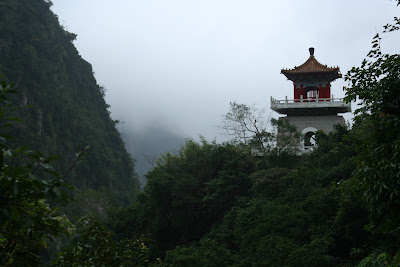
On Wednesday, we took a bus from Taipei down to the city of Hualien, which is halfway down the East coast. Once we arrived in Hualien, we rented a scooter and drove 45 minutes to Taiwan's most beautiful spot: Taroko Gorge. To describe the beauty of this place, I would tell you to imagine the rockiness of Yosemite, put it in a large gorge or canyon, have the bluest river you've seen running through the bottom of it, and cover the rocks and mountains with lush, tropical vegetation. Throw a hot spring and a few macaque (pronounced macow) monkeys in the mix, and you've got Taroko Gorge. It was nature done perfectly. 

We spent two days and two nights hiking the many paths and trails past waterfalls, temples, shrines, and through the forests that cover the gorge. We camped at a nice camp site that had an actual toilet (Taiwan very much embraces the squatter toilets) in the middle of the park and slept to the sound of the river. Having a scooter was the best way to go because the park is quite large and it allowed us to maximize our exploration. We spent both of our evenings at a natural hot spring at the edge of the river. Some people had taken some marble rocks and formed a small pool for the hot spring water to pour into. So even though the cold river was rushing right next to us, we were comfortable in a hot, steamy pool. 

On Friday morning, we were able to hike a special trail that requires a permit. Apparently this trail is not very well advertised, because we practically had the whole trail to ourselves. It was a nice 3.5 hr hike that took us high up the gorge and was the first place where we encountered the macaque monkeys. They kept safe in the trees, but were very curiously watching us the whole time. Seeing monkeys in the wild was one of the highlights of my trip! 


Later on Friday, we were sad to leave Taroko, but knew there was still so much more to see in the country. We drove our scooter back to Hualien, spent a few hours walking around their market area, then took a train down to the Southern tip to an area called Kenting National Park. However, our train only took us to a city North of the park, and we still needed to drive about one hour South to get into Kenting. We figured we'd take a bus, get into Kenting around 9pm, and hopefully find a motel. I was pretty tired and was not feeling thrilled about having to walk around trying to find a motel. Luckily, the lovely Taiwanese people saved the day for us once again. Right as we were walking out of the train station, a young couple was talking to a cab driver and asked us if we would like to share a cab with them to Kenting and split the cost. We decided that'd be a lot more enjoyable and comfortable than taking a bus. Two more girls joined us (it was a large cab) and we went on our way. They all spoke decent English, so we had some pleasant chats with them. 5 minutes into the drive, one of the girls was asking the cab driver about where to buy fruit. All of a sudden, he makes a u-turn and takes us to a fruit market! We all got out and bought a plethora of delicious, local fruits (Mary and I bought a pineapple, some cherries, and a bunch of bananas). We got back into the cab and continued on our way. One of the girls asked us where we were staying that night, and we said we didn't have anything booked yet. All of them were shocked by this bit of news, and so one of the girls got on her phone, spoke to someone in Mandarin for a minute, then asked us, "Do you want a motel on the beach for $30?" Umm, yes we do! And just like that, we had accommodation for the night! And this motel was SO NICE and SO COZY! After spending the last six nights camping and sleeping on a couch, this motel was pretty much heaven. I was hoping to wake up to terrible weather the next day so I could just lie around this cozy room all day, but we woke up to good enough weather and we embarked on our next adventure in Kenting. 

Kenting is a national park unlike any I have seen. It is full of small towns and is quite developed. There were many campy tourist attractions and a bustling night market. It still contained many beautiful nature parks and beaches and we had a wonderful time there. We rented another scooter and drove all over the area. We encountered more macaque monkeys, visited a place where fire literally comes from the ground (there are natural gases constantly rising from the ground and people have ignited these gases. We roasted marshmallows while others roasted popcorn), and went on some nice hikes. We were told the weather would be the best in Kenting, which was one of the reasons we went down there since the weather we'd had thus far was cloudy, slightly drizzly, and about 65 F / 18 C. However, the weather in Kenting ended up being the worst that we experienced for the whole trip. It was cool, rainy, and very windy. On our second day, the wind was so strong that we were nearly blown off our scooter! We ended up having a lazy afternoon that day instead of fight the elements. 


One of the couples that picked us up hitchhiking. 


On Monday, we decided we would take an overnight train from Taitung to Taipei, since we had to be at the Taipei airport Tuesday morning. Since it was New Years eve, we figured finding a cheap motel in Taipei would be almost impossible, so an overnight train seemed like the best idea. So we hitchhiked from Kenting to the train station, then took a train to Taitung. We had about 8 hours to kill there, so we explored the town. It wasn't the most exciting town, but we found a really fun art and music district that was full of local art installments and a park where people were performing music. We drank some coffee there in the park, enjoyed the music, and paroused the vendors selling artwork. 

We were told that there would be some great New Years Eve festivities by the local aboriginal tribes. We were told a general direction to walk to find these festivities, so at 8pm we started walking, hoping to have some sort of celebration for New Years Eve. After about 15 minutes of walking, we found ourselves in a dark, quiet residential neighborhood with no festivities in sight. Discouraged, we contemplated just turning back and heading to the train station. But here came more Taiwanese people to save the day! A van pulled up and asked us what we were doing. After explaining to them what we were looking for, they pointed at the house behind us and told us to go there. We initially thought that was a bit weird to just knock on a random house, but they strongly insisted, so we nervously walked to the door and knocked. When the door was opened, we saw a huge family of about 20 having a New Years party. They called the one English speaker to the door, and we asked him if he knew where the aboriginal festivities were, and he said "They're right here!" And I said, "Wait, this is the aboriginal New Years festivities?" And he said, "Well, we're aborigines, and we are having a celebration. So yes! Come on in!" The whole family started laughing and cheering loudly as they welcomed us into their home. The English-speaker asked us a few questions about ourselves and then translated for the group. 

Soon enough, the family was tired of asking questions and just wanted to party with us. All of the adults were clearly drunk and had red-stained teeth. They sat us down on their couch and began shoving food at us and insisting that we eat, even though we told them we had just eaten dinner. To not be rude, we ate (I more than Mary), and all of the food was actually quite good. They turned on some traditional music and had us stand up and dance with them. We all held hands and did some aboriginal dances around the coffee table. They even dressed Mary and I up in traditional clothes. We were all laughing hysterically and having a great time. I was shocked by how quickly they just welcomed us into their home, included us in their celebration, and were so eager to share their culture with us. 

After about 45 minutes, they told us we needed to go with one of their friends to a larger celebration. We hopped on his scooter (three of us on one scooter!) and he drove us down the road to meet up with a group of approximately 100 men, all dressed in traditional clothing. They were loudly singing songs, banging on drums, and walking from home to home. They would literally walk into these people's homes, fill up the living room, and sing for about a minute. Then, they would all spill back into the street and walk to the next house. Again, they welcomed Mary and I whole-heartedly in this celebration and made sure we were in the heart of it. They explained that part of their culture is to be very inviting and welcome to strangers. Clearly this was part of their culture they strongly embraced! 

At 10pm, it was time for us to head to the train station, so some of our new aboriginal friends drove us back to the station. What started as a New Years we thought would be mellow turned into a New Years we will never forget! We sat down in the train, looked at each other, and said "What just happened?!" It was all such a mad whirlwind of laughing, joyful yelling, eating, taking photos, singing, dancing, and wondering what the heck was going on. It was a perfect end to our trip. 


Getting dressed in traditional clothes.

Dancing around the coffee table.
All in all, this trip was almost perfect. The only thing that could have been better was the weather. But frankly, it was much better than the brutal, winter cold of Korea! We met so many nice people that helped us graciously along our way, like a Mandarin-speaking French man who helped us at the train station after we somehow missed our train. Or the couples who picked us up hitchhiking. Or the many many people who just asked us out of the blue if they could help us with anything. We saw more beauty than I expected to see. We ate better food than we have eaten here in Korea, and for very cheap! And yet, so many people asked us, "So, why did you choose Taiwan for your vacation?" as if we were nuts to want to go there. But we thought they were nuts for even asking. Why wouldn't we want to go to Taiwan?! It was an incredible trip, there wasn't a dull day or an unhappy experience. 

Taiwan, you were great to us! Thank you.


Monday, November 26, 2012

Summer Camp, in Winter, at a Buddhist Temple

Last weekend I partook in a temple stay. What's a temple stay, you ask? Allow me to explain.

Some of the Buddhist temples in Korea allow people to stay overnight, or for many nights, to learn about Buddhism, meditate, chant, and practice other Buddhist activities. With a group of 10 other Pohang foreigners, I stayed at a temple about an hour away. For myself, as well as most of my group, I wanted to learn more about the religion, have an opportunity to have real conversations with Buddhists, and experience a side of Korean culture that has been distant from the modern-day Korea I live in. And for $50, I got just that.

It ended up feeling a bit like summer camp, only instead of sleeping in cabins, we slept in temples. And instead of eating unexciting camp food, we ate unexciting Buddhist food. Instead of singing campfire songs, we chanted prayers. And instead of intertwining God and Jesus into each camp activity, we intertwined the Buddhist principles of inner-peace and proper breathing in everything we did.

The temple stay started at 2pm with a lesson in archery. We were given instructions on how to properly hold and shoot the bow and arrow by a Polish girl who is, I'm assuming, living and volunteering there. I had done archery in the past at the two summer camps I used to frequent as a child, but I learned something new about shooting a bow and arrow. Our arrows were not tipped with sharp arrowheads, but rather with rounded butts. Our Polish instructor explained that if the arrow bounces off the target, that means our breathing was wrong. Only if we breathe properly will the arrow sever the target and stick. Out of the 6 or 7 of my arrows that actually made contact with the target, only one stuck. So clearly I need to work on my breathing.

Afterwards, we watched a performance of Sunmudo, which is considered a meditative martial art. Though it can be used as self-defense, it seems to be more used for personal growth and balance, literally and figuratively. Like everything else, proper breathing is absolutely crucial while practicing Sunmudo, and many moves require big leaping movements that end in perfectly still landings. It reminded me a little bit of yoga, capoiera, tai chi, and tae-kwon-do mixed together.

We then went for a hike up the hill to an engraving of Buddha in the side of a rock that dates back to some time between the 7th and 9th centuries. We continued on through the hills and forest. Although most of the trees have lost their leaves, the maples were still fully clothed and showing oranges and reds about as vibrant as autumn colors come. One fellow in our group asked a monk that day why temples are usually up in the hills. The monk answered that it is because once you walk up that hill to reach the temple, your body and mind are tired, and you are less likely to possess strong feelings, thoughts, and emotions that can disrupt your inner peace.

For dinner, we ate a traditional meal of rice, kimchi, vegetables, and soup. Buddhists are vegetarian, so this meal contained no meat, or any animal product that I'm aware of. We served ourselves and were asked that we not waste any food at all.

After dinner, we were given instruction in Sunmudo. One of the monks had us start with warm-ups, stretches, and the most bizarre exercises my body had gone through. Some of the exercises were quite strenuous, and that was just during the warm-up. Then we stood up and practiced some punching and kicking moves. Most required very quick movements, too quick for most of us to keep up with. At one point we had to do four rapid-fire punches followed by one powerful punch. I couldn't help but laugh at the entire row of people in front of me who were struggling to punch quickly enough so they all just jiggled their rear-ends four times with their fists out in front of them, and then punched once.

We all retired to our rooms at the early time of 9pm, which was a good thing since we woke up at 4am for early morning chants and meditation. Surprisingly though, nobody seemed cranky to be awake at such an early time and walking up a steep hill in the cold to chant words that meant nothing to us. We arrived in the dimly lit temple where a few monks were seated on cushions in the front, facing the large Buddha on the front wall. We all took seats on cushions behind them, with women on the left side of the room and men on the right. We had been taught the night before how to bow, which required getting down on your knees, placing your forehead on the ground, and making certain movements with your arms, then standing back up. They provided us with laminated cards with the words of each chant so we could chant with everyone, and we began, constantly bowing and standing and bowing and standing, and chanting to the beat of the head monk who kept a steady tempo on a wooden hand drum.

Oh the hand drum! Understandably necessary, as we need to chant to the same tempo together. But unnecessarily LOUD. So loud that each whack of the drum pounded my ear drums. I tried to ignore it. I thought to myself:
Inner peace... inner peace... breathing... BANG! BANG! BANG! Ugh, ok, inner peace... inner - BANG! BANG! Roman, ignore it, focus on happy things... peaceful things... pea - BANG! BANG! BANG! BANG! BANG! I want to steal that drum and smash it into tiny pieces and grab the monk by the shoulders, shake him, and scream, 'YOUR INCESSANT DRUMMING IS SO OBNOXIOUS!'

Luckily for myself and everyone in the temple, the drumming ended and we were able to have about 20 minutes of silent meditation. The point of meditation is to clear your mind of everything and think of nothing. Obviously this is easier said than done. One of our instructors told us that a good thing to do to not think is to focus on our breathing, count each breath up to 10, then count down to 1, then back up and so on. Another monk told us to focus on feeling the air moving through our nostrils and brushing past our upper lip. So I focused on these things. I could probably count three or four breaths before my mind would wander. But even focusing on our breathing is thinking, so I'm not sure how that clears our heads. I decided if I was going to inevitably think, I might as well think of good things. So I did. 

Breakfast was quite an ordeal. Dinner was a very casual occasion, but breakfast required the most rigid and stressful procedure of the weekend. Everything needed to be done a certain way, from the placement of each of our four bowls and utensils, the cleaning of our bowls before and after eating, the way we accepted our food from the servers, the fact that we had to eat EVERY SINGLE MORSEL of food, and we had to eat it quickly. When we finished eating, someone came around and poured hot water in one of our bowls. We had to use a piece of kimchi to scrub that bowl, then pour the water into the next bowl and scrub, then into the next bowl and so on. After scrubbing all of our bowls, we were to drink the water and eat the piece of kimchi. It wasn't too bad, and was extremely resourceful! Having to eat every morsel of food is a good practice, something we should all be more conscious of in our own eating habits.

The final event of the temple stay was tea and conversation with one of the monks who spoke English. I was very much looking forward to this so I could ask some questions and learn more about the religion, but unfortunately the combination of the monk's accent and the reverb/echo of the large room made it very hard for me to hear him or anybody else speaking. I could make out about 50% of the words, which made for a frustrating and boring hour. Oh well, I'm told from my friends who could hear  that I didn't miss much. 

I'm glad I finally did a temple stay. It is considered one of those essential activities that foreigners should do in Korea, so now I can scratch that from my bucket list. It was educational, it was slightly challenging at times, and though it did not draw me closer to the religion, it did motivate me to reflect on my current life, think positively, and think about the moment and not worry so much about the past and future. 

One of the monks demonstrating Sunmudo.

We were required to wear these fashionable yellow vests and baggy grey pants during our stay.

Many of the statues looked like this.

The monk who led the tea and conversation time.

The 1100 - 1300 year old carving of Buddha.

Practicing for the Hunger Games.


Wednesday, October 31, 2012

Autumn Adventures

It's officially autumn here in Korea, but I fear it won't last much longer. I have been spoiled with over a month of lovely low-70s temperatures and almost no rain, which has made for many wonderful outdoor activities and adventures. The leaves have been showing off their vibrant yellows, oranges, and reds, and the rice fields have been exhibiting their tall blades of gold and green preceding their near-future harvest. During my entire life I have tried to get excited about autumn, but when I enjoy warm summers and dread winter, autumn has always bummed me out. This year has been a slight improvement, partly because the summers in Korea are not so nice, and I have had a lot of fun this season. But then Mary likes to remind me, in a creepy, sadistic voice, that "Winter is coming!"

Aside from my collection of easy jobs I have been working since my return to Korea, I have been able to partake in some fun activities, the most prominent of which is being the newest member to an ultimate frisbee team. We have two teams here in Pohang that compete in a nation-wide league composed mostly of foreign English teachers. This is the first year Pohang has had teams in the league, and with the exception of a few players, we are all new to the sport. So naturally we were expected to be mediocre at best. But what people from other Korean cities didn't realize is that Pohangsters (yes, that is what we call ourselves) are the most awesome group of foreigners in all of Korea. So of course our two teams have been kicking major butt this year, beating some pretty tough teams! I have struggled with the high amount of running/sprinting involved in this game, but despite that, I feel I have fared quite well for a beginner. The league keeps stats on all of the players, and I can proudly say I have averaged 2.8 points per game!

I have also done a fair amount of dressing up in fantastic costumes. The first of which was for a joint birthday party for two friends. A recent craze among the Pohang foreigners has been to purchase cute animal costumes. You can choose from around 50 different animals from a website, and our community probably has all 50 represented! (I was given a flying squirrel costume for my birthday) So these two friends decided to ask everyone to wear their animal costumes for their birthday party. It was an adorable night of the cutest and happiest animals the world ever saw.

Then came Halloween. Two friends of mine had the brilliant idea of gathering a big group of foreigners in downtown Daegu (Korea's third-largest city) dressed and painted as zombies to do a zombie walk through the city streets. Approx. 100 of us showed up with faces painted and clothes representing various forms of zombies (I was a disco zombie) and we walked for about 45 minutes through the busy streets with one purpose: scare the bajeezus out of Koreans! Luckily for us, Koreans are easily frightened. We had them screaming, running, hiding, and then of course taking photos with us. We were quite the sensation, and fortunately the general public was more pleased and entertained than disturbed by our antics. Halloween is hardly celebrated or acknowledged here, so this was just one more thing we foreigners could graciously share with this country.

Like Mary says, winter is coming. And I can't help but be reminded about my dismal chapter last winter in Korea. But there are things to look forward to, such as the mosquitos leaving, being able to snowboard on the weekends, being able to stay home watching movies and not feel guilty, and spending the holidays in Taiwan. And lastly, I am looking forward to seeing this election season end! I cannot wait for news headlines to stop being about election polls, I cannot wait for the end of needing constant fact-checking because people can't seem to tell the truth, and I cannot wait until I can stop hearing the same political platforms that I've been hearing for the last year! Korea has a presidential election in December, and most people still don't know much about the candidates because the real campaigning has hardly begun. Doesn't that sound nice? Sounds like a dream come true to me!

I am going to spend the last remaining days of autumn enjoying this weather, enjoying the end of frisbee season and having picnics and walks along the beach and not having the moisture sucked dry from my skin by bitter cold.

My ultimate frisbee team, the Pohang-Overs

Psychedelic face paint courtesy of Mary
Disco Zombie
Pohang's Scariest Zombies

Slack-Lining at the Park (yes, I am balancing on a thin strap)

Cute Animal Party
Mary and I performed at a Breast Cancer Awareness Talent Show (hence the pink shirts)